










CIRC Circle Touch Rules
Revised 3/3/2026
The goal of this contest is for a robot to negotiate obstacles set up on a table in order to find and touch circles placed around the table. The unique challenges to this event are negotiating the obstacles, the touching of the circles, and returning to base to score as many points as possible within a set time period.
- Overview:
- The base is where the robot starts from and returns to.
- The robot may be touched by the operator without penalty when the robot is in the base.
- The robot is considered to be in the base once it is inside the lines of the base or touching the lines of the base.
- Three or more crossed circles are spread around the table for the robot to touch. All circles will be the same.
- Obstacles in the form of walls are arranged on the table in a manner that makes the touching of the circles challenging.
- The obstacles will be on a grid.
- The circles will not necessarily be on the grid.
- The robot scores points for touching the circles and indicating that it knows it is touching a circle.
- Points are collected when the robot is out on a trip, but are only scored (“banked”) when the robot returns to base.
- The robot can touch the circles and base in any order.
- The robot can collect points for retouching a circle after touching another circle or the base.
- When returning to base, the robot scores the value of the highest circle touched on that trip (in addition to all of the unbanked points it has collected).
- When a robot touches all the circles on a trip and returns to base, it will receive a bonus. (Grand Tour Bonus)
- The robot can make as many trips out and back as time allows.
- The operator may retrieve the robot when not in the base, but any points collected on that trip will not be scored.
- The robot has 2 ½ minutes to score as many points as possible.
- Robot Requirements:
- The robot must fit completely within the base.
- When the robot leaves base, it must completely leave the base and move as a single unit, i.e. no tethering.
- The robot should be able to negotiate the obstacles on the course. The closest the walls could be to each other is 6 ½”.
- The robot may not be built such that it will damage the course.
- The robot must be autonomous.
- The robot may not receive human input during a trip.
- The robot may not use internet access.
- All cameras or sensors must be on the robot.
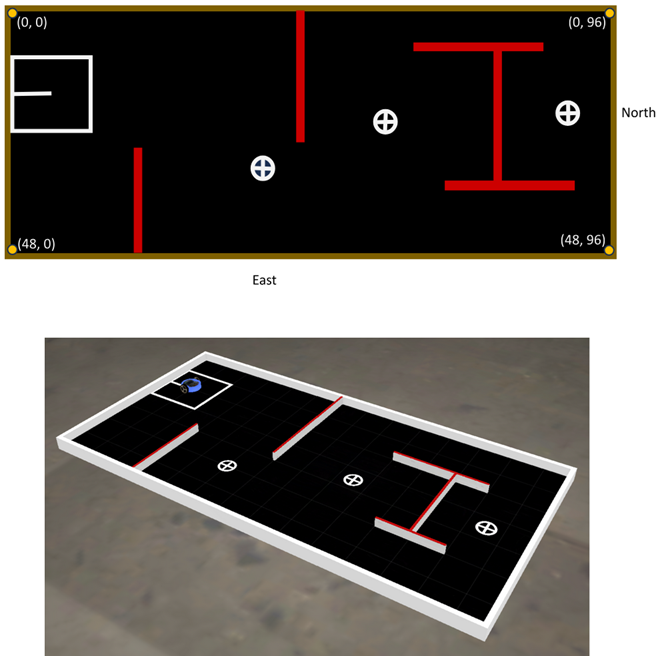
- Layout of area and obstacles: Sample pictures shown below.
- The course is on a black 4 foot x 8 foot table with approximately 2 inch high walls around the outside.
- All walls used as obstacles will have white sides, red tops, a height of 2 inches, and be affixed to the table.
- The base will be a square of 4 grids. It will be marked with ¾ inch white electrical tape.
- There will be a white line in the Home Base that can be used to define North for your robot.
- Circles will be white rings with a 4 inch outside diameter. The lines for the circles will be ½ inch.
- Northerly and Easterly lines will cross in the center of each circle. The length of the table is defined as North-South. The width of the table is designed as East-West.
- The circles will be placed around the table amongst the obstacles.
- The surface of the table will be black. The walls, base lines, and circle lines will be white.
- The obstacles will be on a 7 inch grid.
- In the drawing below, the top left corner of the table will be designated as (0, 0).
- The base, circles, and obstacle locations will be held constant for all contestants.
- The operator can touch the robot when it is in Home Base without penalty.
- When the robot is touched outside of the Home Base, it must be returned to the Home Base.
- Scoring:
- A robot touches a circle if any part of it passes over the circle and it signals it is touching the circle. Signals must be a pause, direction change, or wiggle, with a sound and light flashes. The touching and signals must happen at the same time, and be obvious. Obvious is defined by the referee. If a contestant wonders if their pauses, wiggles, sounds, or light flashes are obvious to the referee, discuss with the referee beforehand.
- Points for touching a circle are as follows. Circle 1 is worth 1 point, circle 2 is worth 2 points, circle 3 is worth 3 points, and so on.
- Being inside the base lines or touching any part of the Home Base outline is considered returned to base.
- Points for returning to base are the point value of the highest circle touched on that trip.
- Points for touching a particular circle may be earned multiple times during a trip if the robot touches a different circle in between.
- The Grand Tour Bonus will be worth 2 points.
- A judge will determine and announce all circle touches. His word is law. Tips are appreciated.
- There is no penalty for contacting the walls or obstacles.
- Procedure:
- There will be a 30-minute practice period before the contest starts. Contestants are expected to share the arena for practice.
- Contestants will be able to measure the locations of the circles and walls prior to competing.
- It is acceptable to run the robot under operator control on the course during the practice time in order for the robot to learn the course.
- The order of competitors will be randomly determined by the judges.
- For the competition, each contestant will have 2 ½ minutes to score as many points as possible.
- The operator may pick up their robot to return it to base. Points collected on that trip will not be scored.
- There cannot be any cues or inputs from any human being directly or indirectly while the robot is running the course.
Sample Layouts: Not drawn to scale.