










CIRC Drag Race Rules
Revised: 3/3/2026
- The Drag Race
-
- The aim of this competition is for the bot to travel as fast as possible over a straight course similar to full-sized automobile drag racing. The bots are required to stop at the end of the course. Cushions will be used to catch them if they cannot stop on their own.
- The competition is run in a head-to-head format.
- The time is used to determine the winner of each match and for seeding of the subsequent round.
- A match consists of one head-to-head run of the course.
- Brackets will be double elimination and the initial order will be random. Subsequent rounds will be seeded based on time.
- Practice runs will be allowed. There is no limit to the number of practice runs each contestant can take during the practice session. The length of the practice session will be set by the judge.
- The runs begin when the judge indicates go and are finished when the robot crosses the finish line. The first robot across the finish line is designated the winner of that race.
- The judge will use the same call pattern for starts.
- Rules
-
- Bots must be battery powered and reasonably sized. They can’t interfere with the other contestant and must negotiate the timing system, i.e. not be too wide.
- Bots are placed at the start line and may start once the start light and sound are activated. When the start light and sound are activated, a wireless signal will be sent with a Sony infrared remote for properly equipped robots to start.
- If the robot is not properly equipped to use this automatic start system, then the person can use a push button to start the robot.
- It is desired that contestants stop in the Braking Area autonomously after crossing the Finish line. The robots that do not stop in the Braking Area autonomously will be penalized 1 second.
- Bots will be disqualified for:
- Jumping the start two times.
- Interfering with the bot in the other lane in any way.
- Being manipulated by people between the start and finish lines once the race has started.
- Leaving the track area before crossing the finish line.
- Contacting any part of the timer system.
- Track details
-
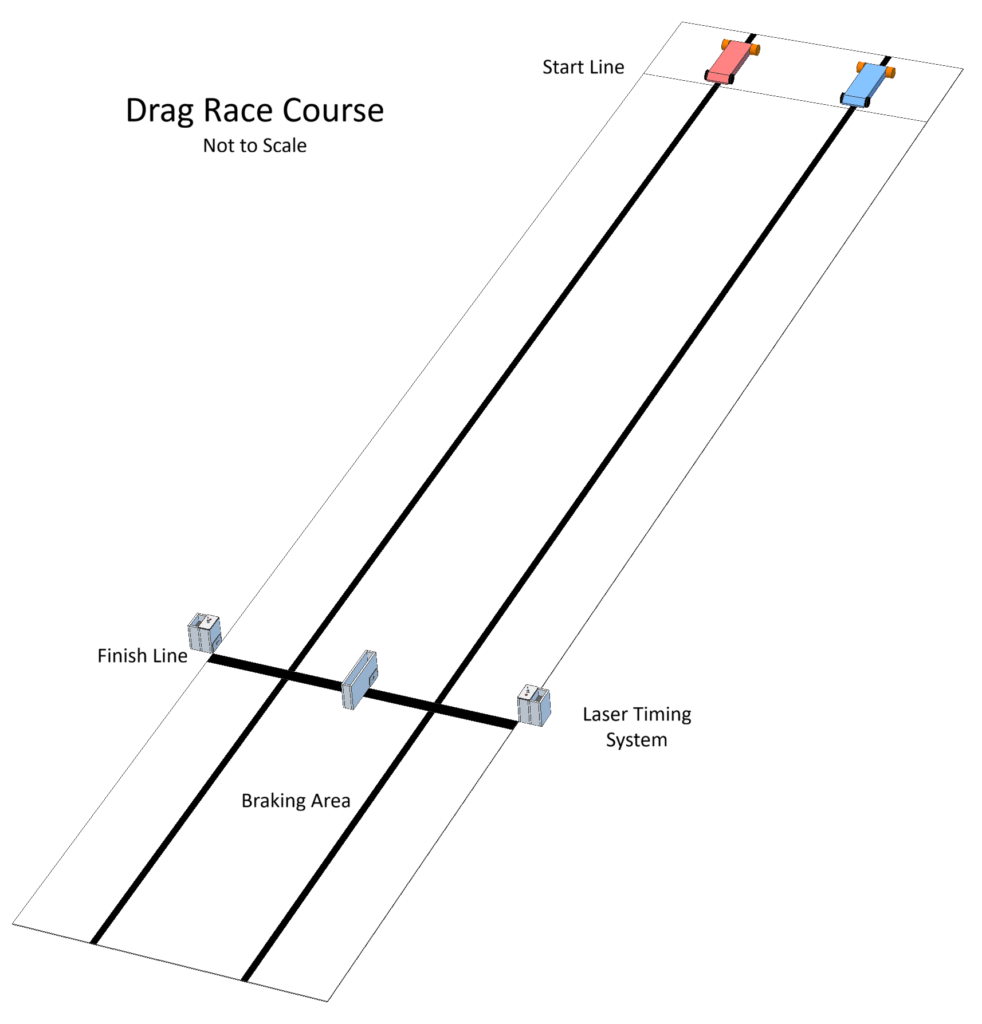
- The sample course shown below is for reference purposes only.
- The race will be run on 4 pieces of white foam core board, 3’ x 4’ each, attached end to end with white electrical tape.
- Standard black electrical tape was used for the following line. The tape was manually applied to the foam board. The line has a nominal width of ¾”.
- The start line will be drawn with a pencil.
- The finish line will be a double wide strip of electrical tape, so about 1 ½” wide.
- The racing section for each lane on the track is 13’ feet long, start to finish.
- The start and finish lines extend at least 6” from both sides of the central black lines.
- The start box occupies the first approximate 12” of the track.
- The braking area comprises the final 24” of the track. There will be cushions placed around the braking area in order to stop robots if needed.
- The track will be laid as flat as possible, but bots should be able to cope with small bumps and rolls in the surface.
- There will not be walls along the edge of the track to stop bots from leaving the track.
- Specific dimensions for this track:
- The race lines are 17 1/4” center to center from each other.
- The lines are 9 3/8” center to the edge of the boards.
- The starting line is 12” from one end.
- The finishing line is 24” from the other end.
- The racing section will be 13’ long.
- The total length of the course is 16’.
- The timing towers for each lane are 16” apart, or each part is 8” from the center lines.