










CIRC Line Following Rules
Revised: 1/14/2026
Robot:
The robot must be completely autonomous once the operator starts it. There is no size or weight limit, but the builder should be aware of the distance between lines and the distance between lines and the wall.
Course:
The course will be on a 4-foot by 8-foot table with an approximately 2-inch-high fence along the outside.
- The course will be printed on a white material that is similar to photo paper, wallpaper, or banner material. The lines will be printed black.
- The lines will be 3/4 inch and colored black.
- The lines will be no closer than 4 inches edge to edge to each other.
- The lines will be no closer than 4 inches to the walls measured from the edge of the line to the edge of the wall.
- The accuracy of the lines is within a quarter inch.
- The mat could be attached to the table by carpet tape or blocks discretely placed around the edges as needed.
- There may be corners on the course. These corners will be no sharper than 135 degrees.
- The curves will have a radius of 3 inches or greater.
- The course will not cross itself.
- The course will be continuous.
- The course is a loop.
- The contestant chooses the direction for the robot to go around the lap.
- Timing:
- Lap times will be based on successive crossings of a fixed point on the course chosen by the judges.
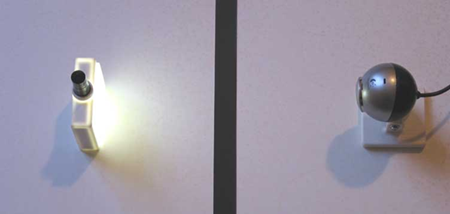
- At the organizer’s discretion there may be a sensor on the course used for time measurement that may be similar to the image below.
- If a sensor is not used, a manual stopwatch will be used.
Procedure:
- There may be a sample course available for calibration purposes before the event. If not, competitors will be able to use the official course.
- There will be a 30-minute practice session before the contest starts. Contestants are expected to share the course that is used for practice.
- The order of competing will be randomly determined by the judges.
- Each robot shall be permitted at most 3 runs.
- The competitors will take turns running the track and will have the option to take 1 or multiple runs at a time within the constraint of 3 runs total.
- The judges will, at their discretion, determine when to end the competition.
- All lap times for each robot will be recorded.
- If the contestant does not complete the course, the greatest distance covered on the path will be recorded.
- There cannot be any cues or inputs from any human being directly or indirectly while the robot is running the course.
- The robot will be considered off course if it completely leaves the line and does not find its way back near the point that it left the line and in the appropriate direction.
- If the robot goes off course and relocates the course at an advanced position, it will be considered to have run off the course. Its run will be over and it will be credited with the distance covered.
- The fastest time or greatest distance covered wins the competition.
- The robot must not damage the course.
Final note on the rules:
The intent of this event is for the robot to follow the line around the loop. If the judge interprets a competitor’s actions as attempting to circumvent this intent, then the judge has the right to disqualify that robot from this event and possibly the competitor from the entire competition. Someone entering the layout of the course into the robot in some fashion will be interpreted as trying to circumvent the intent of this event. This decision will be made in partnership with other members of the club.
The interpretation of these rules is up to the judges on the day of the competition. All judges’ decisions are final.
Example of timing system. The system used may be different.